
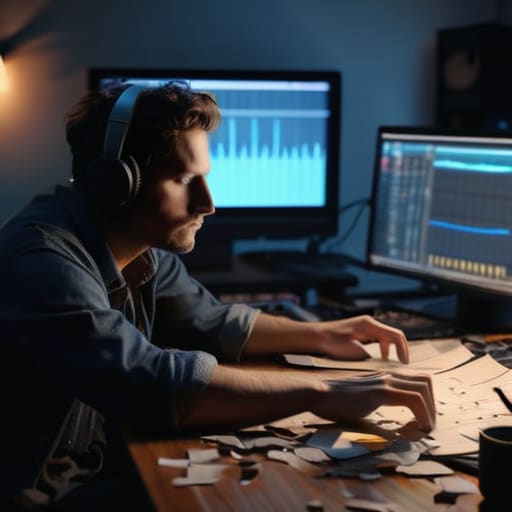
I spent three hours last Tuesday staring at a waveform that looked like a mountain range of pure, unadulterated garbage. I was trying to piece together a narrative arc for a documentary series, but every time I played the sequence back, it felt clunky, hollow, and frankly, embarrassing. If you’re currently staring at your own messy timeline or a script that reads like a grocery list, you’ve probably been told that you just need “creative flow” or a better mindset. That’s nonsense. The truth is that learning how to sit with a bad first draft isn’t about finding your muse; it’s about developing the calloused skin required to endure the middle part of the process without hitting the delete key in a fit of rage.
I’m not here to sell you a productivity masterclass or tell you to manifest a masterpiece. I’m going to tell you how I actually get through the sludge. We’re going to talk about the specific, unglamorous mechanics of separating the recording from the editing and why you need to let your initial ideas be mediocre so you can eventually make them good. This isn’t about inspiration; it’s about the technical discipline of staying in the chair until the work actually starts to function.
Navigating the Messy Middle of Drafting Without Quitting
Navigating the Messy Middle of Drafting Without Quitting
When you hit that midpoint where the initial excitement has evaporated and you’re staring at a pile of disjointed notes, you’ve entered the messy middle of drafting. This is where most people quit. They think the lack of momentum means the idea is dead, but usually, it just means you’ve run out of easy wins. In audio, we call this the “slog”—it’s that period between having a great interview and actually having a coherent story. You have to stop looking for the finish line and just focus on the next 500 words or the next ten minutes of transcript.
The secret to getting through it is strictly separating drafting from editing. If you try to fix a clunky sentence while you’re still trying to figure out the structural arc of the episode, you will stall out every single time. I spent years trying to polish my scripts as I went, only to realize I was just rearranging deck chairs on a sinking ship. Write the bad version. Let it be repetitive, let it be thin, and let it be awkward. You can’t fix a blank page, but you can always fix a bad one.
The Psychology of Creative Frustration and Why Its Normal

The thing no one tells you is that your brain is actually wired to fight you during this stage. When you’re staring at a page of disjointed thoughts and clunky sentences, your internal critic isn’t just being difficult; it’s doing its job too well. You start feeling like a fraud because the gap between the brilliant idea in your head and the mediocre reality on the screen feels insurmountable. This is the core of the psychology of creative frustration, and it’s usually triggered by the subconscious belief that if it isn’t perfect immediately, it’s a failure.
In my experience, the only way through is separating drafting from editing in your mind. If you try to judge the quality of your work while you are still in the middle of the mess, you will stall out every single time. You have to accept that the frustration isn’t a sign that you lack talent; it’s just a physiological response to the friction of creation. It’s a sign that you’re actually doing the work, rather than just daydreaming about it.
Five ways to stop fighting the page and start finishing
- Separate the recording from the mixing. In audio, if you try to EQ the room out while you’re still trying to find the story, you’ll end up with a polished mess that says nothing. Do the same with your draft. Get the words down—even the ugly, repetitive ones—and don’t you dare touch a single comma until the structure is actually there.
- Set a timer for twenty minutes of “low-stakes” writing. I call this the garbage pass. Tell yourself you are intentionally writing something mediocre. It lowers the stakes and bypasses that paralysis that comes from trying to make the first sentence sound like a finished documentary script.
- Keep a “cut list” for your bad ideas. When you hit a sentence that feels too precious or a tangent that’s beautiful but useless, don’t delete it and don’t let it derail you. Just move it to a separate document. It gets the clutter out of your main workflow without the emotional sting of losing a “good” thought.
- Stop looking for the “perfect” word. If you’re stuck on a specific adjective for ten minutes, you aren’t writing; you’re stalling. Put a placeholder like [INSERT SMART WORD HERE] or [BETTER DESCRIPTION OF THE ROOM] and keep moving. You can fix the vocabulary in the second pass; you can’t fix a blank page.
- Accept the “eight-month slump.” There is a period in every project where the initial excitement has evaporated and the finished product feels impossible. This isn’t a sign that the idea is bad; it’s just the middle of the process. Sit in the discomfort, finish the draft, and deal with the quality issues once the skeleton is built.
The Essentials for Surviving the Mess
Stop trying to edit while you draft. If you find yourself trying to fix a sentence in paragraph one before you’ve even reached paragraph four, you’re just stalling. Get the raw audio—or in this case, the raw text—down on the page first. You can’t fix a blank page, but you can fix a disaster.
Treat your first draft like a rough assembly of a documentary. It’s supposed to be clunky, out of order, and full of dead air. Your only job right now is to prove that the story exists, not to make it sound professional.
Lower your expectations for the output to zero. If you go into a session expecting a masterpiece, you’ll quit the moment you hit a snag. If you go in expecting a pile of scrap that you’ll eventually refine, you’ll actually finish the work.
The Edit is Where the Work Actually Happens
You have to stop treating your first draft like a finished product and start treating it like raw, uncompressed audio. It’s going to be noisy, the levels are going to be all over the place, and half of it is probably junk—but you can’t fix a silence, and you certainly can’t mix a track that doesn’t exist. Just get the noise down so you have something to cut later.
Nadine Okafor
The Long Game
At the end of the day, sitting with a bad draft isn’t about some mystical connection to the muse; it’s about technical endurance. You’ve acknowledged that the psychology of the slump is real, you’ve navigated that messy middle where every sentence feels like a lie, and you’ve accepted that your initial output is likely going to be unlistenable. The goal isn’t to write a masterpiece on your first pass—that’s a recipe for a broken hard drive and a burnt-out producer. The goal is simply to get the raw material onto the timeline so that you actually have something to edit. You can’t fix a blank page, and you certainly can’t polish a thought that only exists in your head.
I’ve spent decades looking at waveforms and script outlines, and if there is one thing I know, it’s that the craft is won in the second, third, and fourth passes. The first draft is just the messy, unglamorous scaffolding that holds the project up while you figure out what it actually wants to be. Don’t let the gap between your taste and your current ability make you quit. Just keep the tape rolling, keep the files saving, and remember that every great episode you’ve ever heard started out as a pile of absolute rubbish.



