
I remember sitting in a cramped studio in Birmingham fifteen years ago, staring at two high-profile guests who were currently engaged in a polite but utterly suffocating disagreement. I had the levels set, the mics were hot, and I was completely paralyzed because I had no idea how to steer the ship. Most “experts” will tell you that you need a sophisticated multi-channel mixer or a degree in social psychology to master this, but they’re selling you a fantasy. The truth is, learning how to interview two guests at once isn’t about fancy hardware; it’s about managing the unpredictable physics of human conversation before it turns into a shouting match or a series of awkward silences.
I’m not here to give you a lecture on “synergistic dialogue” or sell you a masterclass. I want to talk about the actual mechanics: how to position your chairs so they don’t ignore each other, how to use your own voice to bridge the gaps, and how to stop one person from accidentally steamrolling the entire recording. I’ve spent decades cutting through the noise, and I’m going to show you the practical, slightly messy reality of managing a multi-person dynamic without losing your mind—or your audio quality.
Mastering Podcast Hosting Multi Guest Dynamics
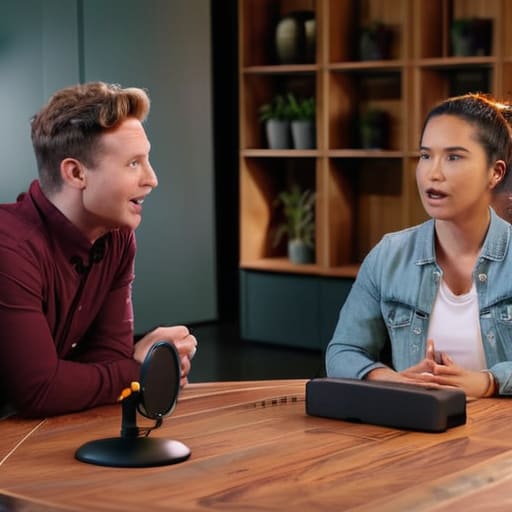
The moment you have two people in the room, you stop being just an interviewer and start acting as a traffic controller. Managing conversational flow is where most beginners trip up; they sit back and let the guests drift into a private conversation that excludes everyone else. You have to be the one holding the invisible thread. If Guest A is on a roll and Guest B is looking at their lap, you need to intervene. I don’t mean cutting them off mid-sentence—that sounds terrible in the edit—but rather using a verbal bridge to pull the second person back into the light.
The real trick to mastering podcast hosting multi-guest dynamics is learning when to be silent and when to step in. You’ll find that active listening for moderators is actually more about watching body language than listening to words. If you see someone leaning forward or opening their mouth to speak, that is your cue to wrap up the current point. If you don’t, you’ll end up with a recording full of overlapping voices that are a nightmare to clean up in post-production. Control the tempo, or the guests will do it for you.
Managing Conversational Flow When Things Get Loud
When you have two guests in the same room, the biggest threat to your edit isn’t a bad mic—it’s the collision of voices. People naturally want to build on each other’s points, which is great for chemistry, but it’s a nightmare for managing conversational flow. If they start talking over one another, you’re left with a muddy, unintelligible mess that no amount of EQ or compression can save in post-production. I’ve sat through sessions where the audio was so cluttered I had to scrap entire segments because I couldn’t tell who was saying what.
The trick isn’t to be a drill sergeant, but you have to be the traffic controller. If you see one guest leaning in to jump a gap, use a physical cue—a slight nod or a hand gesture—to signal that you’re still directing the current thought. Avoiding guest interruptions requires you to be more active than you would be in a one-on-one; you have to lean into your role as a moderator. If the volume spikes, don’t be afraid to step in with a “Hold that thought, Sarah, I want to make sure Mark finishes this point first.” It feels clunky in the moment, but it’s much cleaner than trying to fix a crosstalk disaster later.
Five ways to stop the conversation from turning into a shouting match
- Check your signal-to-noise ratio before you even hit record. If you have two guests in one room, you aren’t just recording two voices; you’re recording the spillover of Guest A into Guest B’s microphone. If they are sitting too close, you’ll never be able to EQ them separately in post without it sounding like a hollow mess. Keep them at least three feet apart and use cardioid patterns to create some breathing room between the tracks.
- Establish a “hand-off” protocol during the pre-interview. I tell my guests plainly: “If you want to respond to something, wait for a beat of silence.” It sounds patronizing, but without that instruction, you’ll end up with a waveform that looks like a solid block of white noise because everyone is talking over each other.
- Don’t be afraid to use your hands as a physical moderator. When the energy gets high and people start competing for airtime, a small, non-verbal gesture—like a slight palm-down motion—can signal to a guest that they need to wrap up their point without you having to interrupt them verbally and ruin the flow.
- Use “name-tagging” to direct the flow. When you ask a question, don’t just throw it into the void. Say, “Sarah, I want your take on this, and then I’ll get Mark’s perspective.” It gives the guests a roadmap so they aren’t guessing who is supposed to be speaking, which prevents that awkward, heavy silence where everyone is waiting for someone else to go first.
- Plan for the “accidental tangent” by having a backup question for each person. In a two-guest setup, the conversation will inevitably veer off into a shared interest that excludes you. When that happens, don’t just let them drift into a private conversation for twenty minutes. You need a specific, targeted question ready to pull the focus back to the episode’s actual topic.
The Reality Check: What You Actually Need to Carry Away
Don’t wing the seating arrangement; if they aren’t facing each other or you, you’ll spend the whole hour fighting for eye contact and losing the thread of the conversation.
You are the traffic controller, not a passive listener; if one guest starts a monologue that’s drifting into the weeds, you have to cut them off politely but firmly before the audio becomes a mess of overlapping voices.
Check your gain levels for two different voices before you hit record, because the person who speaks quietly and the person who shouts will never sit at the same level on your waveform without a specific plan.
The Myth of the Natural Conversation
Don’t fall for the trap of thinking a three-way conversation will just ‘happen’ because you’re all smart people in a room. If you aren’t actively directing the traffic, you’ll end up with two people shouting over each other and one person staring at their shoes in silence, and no amount of EQ in post-production is going to fix that level of awkwardness.
Nadine Okafor
The Reality of the Multi-Guest Mix
At the end of the day, managing two guests isn’t about achieving some perfect, televised harmony; it’s about preventing the audio from turning into a sludge of overlapping voices. You need to keep your mic technique tight, your seating arrangement intentional, and your hand signals ready for when the conversation starts to spiral. If you can control the physical space and stay ahead of the conversational pivots, you’ve already won half the battle. It’s going to be messy, and you will almost certainly have to cut out three minutes of cross-talk in post-production, but that’s just part of the job. Focus on the technical groundwork and the structural flow, and the rest usually sorts itself out.
Don’t let the fear of a chaotic recording session stop you from trying more complex formats. Most of the “pro” sounding shows you listen to were built on a foundation of failed experiments and awkward silences that never made it to the final edit. The skill comes from the repetition—from the dozens of times you’ll have to step in and say, “Let’s circle back to that” just to keep the ship upright. It’s unglamorous work, but once you find that rhythm where the chemistry actually clicks, it becomes the most rewarding part of the craft. Just keep recording, editing, and learning from the mistakes that didn’t make the cut.




